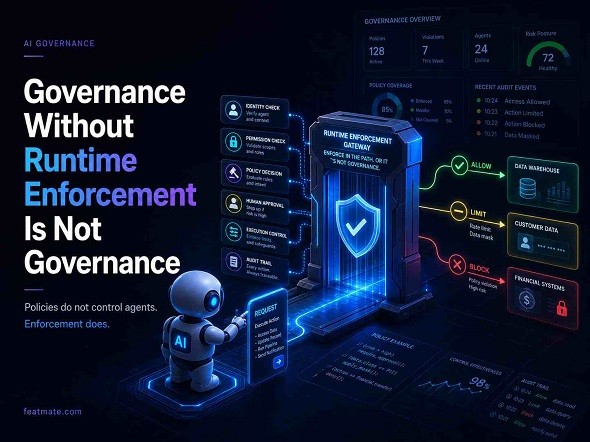
Governance Without Runtime Enforcement Is Not Governance
A chatbot that produces a questionable answer creates one category of risk.
An AI agent that can use credentials, call APIs, update records, change infrastructure, or trigger financial transactions creates a very different one.
The distinction is authority.
Once an AI system can act beyond the boundaries of a conversation, policies and dashboards are no longer enough. Organizations must be able to determine which agent is acting, whose authority it is using, what resources it can reach, and whether a proposed action should be allowed before it happens.
That is where AI agent governance becomes an engineering problem rather than a documentation exercise.
NIST is now explicitly working on standards for identifying, managing, and authorizing actions performed by software and AI agents. OWASP likewise treats tool use, memory, permissions, and autonomous action as security surfaces that require controls beyond conventional prompt filtering.
The central principle is straightforward:
| Governance should be measured by what it can enforce, not only by what it can report.
What Is AI Agent Governance?
AI agent governance is the system of ownership, identity, authorization, policy enforcement, oversight, evidence, and lifecycle controls used to govern autonomous or semi-autonomous agents.
Traditional AI governance commonly concentrates on:
- Training data
- Privacy
- Model evaluation
- Fairness
- Content safety
- Regulatory compliance
- Model risk
Those concerns remain important. But an agent introduces another layer: execution.
An agent may decide which tool to use, retrieve information from several systems, maintain state, delegate work to another agent, and perform a sequence of actions with limited supervision. OWASP defines AI agents in similar operational terms: systems that reason, plan, use tools, maintain memory, and take actions to achieve goals.
Model governance asks:
| Should this AI system produce this output?
Agent governance must also ask:
| Should this agent be allowed to act on that output, against this resource, using this authority?
That question cannot be answered reliably by a policy document after the action has already occurred.
Why Traditional Governance Breaks at Runtime
Many organizations already have AI policies, risk registers, model inventories, and governance dashboards.
These controls can help teams understand where AI is used and which policies apply. But they may not prevent an agent from performing an unsafe or unauthorized action.
Consider an agent that is instructed to resolve a customer billing issue.
Its language output may be appropriate. It may explain the situation accurately and select a seemingly reasonable next step.
But the operational risk depends on another set of questions:
- Which customer records can it access?
- Can it issue a refund?
- What is the maximum amount?
- Can it modify several accounts in one workflow?
- Does it use its own identity or the employee’s identity?
- Does approval apply to the exact transaction?
- Can the credential be revoked immediately?
A content filter cannot answer those questions.
Neither can an audit dashboard that updates after the refund is completed.
Runtime AI governance begins at the point where the system must choose among several actions:
- Allow
- Reduce the scope
- Redirect
- Require approval
- Block
Google’s Agent Gateway architecture reflects this shift by placing policy enforcement in the communication path between agents, tools, services, and other agents. Microsoft’s current guidance similarly emphasizes identity, conditional access, role-based authorization, and least privilege for autonomous agentic systems.
Monitoring explains what happened.
Runtime enforcement decides whether it should be allowed to happen.
The Featmate Runtime Agent Governance Framework™
A useful governance model should cover the complete journey from discovering an agent to containing it when something goes wrong.
Discover
↓
Identify
↓
Authorize
↓
Enforce
↓
Audit
↓
Contain
Each stage addresses a different control gap.
1. Discover Every Agent Before Attempting to Govern It
An organization cannot govern an agent it does not know exists.
Agent inventories should record more than the name of an application. They should identify:
- Where the agent runs
- Its purpose
- Its owner
- The model and framework it uses
- Its tools and integrations
- The data it can access
- The credentials assigned to it
- Its production status
- Its last activity
- Its dependent agents or workflows
Without this visibility, organizations risk creating shadow agents: automations that remain connected to production systems after their original project, team, or owner has changed.
An agent may still possess a valid API key even though nobody actively maintains it. Another may have been duplicated for testing and accidentally connected to a production resource. A third may be operating through credentials owned by a departed employee.
Google’s enterprise governance model treats discovery, security, and auditing as connected pillars rather than separate administrative tasks. This reflects an important operational reality: inventory data must remain connected to identity, access, activity, and lifecycle state.
A spreadsheet listing known agents is a starting point.
It is not continuous governance.
2. Give Every Agent an Identity and an Owner
Every production agent should have a unique identity.
Shared credentials make it difficult to establish:
- Which agent performed the action
- Which user delegated authority
- Which policy applied
- Which owner is accountable
- Which access should be revoked
Agent identity is now becoming a formal part of enterprise IAM. Google, for example, documents cryptographically attested identities that allow an agent to authenticate to cloud resources, MCP servers, endpoints, and other agents either independently or on behalf of a user. NIST is also exploring standards-based approaches for AI agent identity and authorization.
However, identity alone does not create accountability.
Each agent also needs:
- A named operational owner
- A clearly defined purpose
- An approved risk level
- A lifecycle status
- A review schedule
- A revocation process
Identity answers:
| Which agent acted?
Ownership answers:
| Who is responsible for the authority given to it?
Agents should not simply be treated exactly like employees. They can be short-lived, replicated automatically, delegate work recursively, and change their behavior according to context and memory.
They need first-class identities, but their authorization model must account for autonomous execution.
3. Apply Least Privilege to the Task, Not Just the Application
An agent should receive only the authority necessary to complete its current task.
This principle sounds familiar, but agents make it harder to implement because they can combine several tools and decisions into one workflow.
Access may need to be limited by:
- Tool
- Resource
- Environment
- Data classification
- Read or write operation
- Transaction amount
- Number of affected records
- Duration
- Specific task
A coding agent that prepares a pull request does not require deployment credentials.
An infrastructure-review agent does not require permission to apply Terraform.
A support agent handling one customer case does not require unrestricted access to every customer account.
Microsoft’s latest least-privilege guidance for AI agents frames identity, resource scope, tool access, auditability, and revocation as design requirements that should be established before agent autonomy expands. OWASP also recommends least-privilege access for agent tools and strict control of the agent’s execution surface.
Credentials should preferably be:
- Short-lived
- Task-scoped
- Environment-specific
- Revocable
- Read-only by default
Multi agent systems need an additional rule:
| A sub agent should receive less authority than its parent, not an automatic copy of the parent’s permissions.
Delegation should narrow authority.
It should not reproduce it.
4. Enforce Policy Before the Tool Call Executes
Runtime enforcement is the point where governance becomes operational.
Before an agent invokes a tool or changes a system, a policy layer should evaluate the proposed action.
The decision may depend on:
- Agent identity
- Delegating user
- Tool selected
- Target resource
- Requested parameters
- Data sensitivity
- Current environment
- Transaction threshold
- Risk level
- Previous actions in the workflow
The enforcement layer should be able to:
- Permit the action
- Convert it to read-only
- Limit the affected records
- Reduce the transaction amount
- Redirect it to a safer workflow
- Require human approval
- Block it entirely
This creates a useful separation between the agent’s reasoning and its authority.
The agent may propose an action.
It should not automatically possess the capability required to perform every action it can propose.
Google’s Agent Gateway is explicitly designed as an infrastructure enforcement point for agent-to-agent and agent-to-tool interactions. OWASP’s guidance similarly highlights the need to control tools, permissions, and execution rather than relying solely on model-level protections.
This architecture also reduces blast radius.
If an agent behaves unexpectedly, the enforcement layer can still restrict what reaches the target system.
5. Make Human Approval Control the Actual Capability
Human in the loop is frequently presented as the answer to high-risk agent actions.
But the presence of a human somewhere in the workflow does not automatically create an effective control.
Weak approval patterns include:
- Approving a natural-language summary
- Approving a general intention
- Approving before the final parameters are generated
- Allowing the agent to retain write credentials
- Reusing an approval after the action changes
- Approving a workflow without seeing the target resource
Suppose an agent asks:
| “May I update the customer account?”
The reviewer clicks Approve.
But the approval does not specify:
- Which account
- Which fields
- Which tool
- Which amount
- Which credential
- How long the approval remains valid
The human approved an idea, not an executable transaction.
A stronger approval control should bind authorization to:
- The exact action
- The exact tool
- The exact parameters
- The exact resource
- The maximum permitted scope
- A short expiration time
- A single execution
If the agent changes its plan, the approval should expire.
For high-risk operations, Microsoft recommends workflows that pause for human review before execution, including external data transfers and system-configuration changes.
The critical architectural principle is that the approval service not the agent should control the capability required to execute the action.
Otherwise, the approval may be little more than an acknowledgement.
6. Capture the Authority Chain, Not Just the Event
Traditional application logs may record that an API call occurred.
That is not always enough for agent accountability.
A useful agent audit record should be able to reconstruct:
- Which agent acted
- Which user or service initiated the task
- What authority was delegated
- Which context informed the decision
- Which tool was selected
- Which parameters were used
- Which policy decision was returned
- Whether human approval was required
- Who approved it
- Which resource changed
- What the final result was
This matters because an agent action may be the result of a long chain:
User Request
↓
Primary Agent
↓
Planning Step
↓
Sub-Agent
↓
Tool Selection
↓
Policy Decision
↓
Human Approval
↓
Execution
Recording only the final API request hides the structure that produced it.
Strong auditability should allow security and engineering teams to explain not only what happened, but also:
- Why it was permitted
- Under whose authority
- Through which delegation path
- Within which policy boundary
NIST’s agent identity work and Google’s agent governance architecture both emphasize traceability and auditing as essential components of secure agent deployment.
7. Build Containment Before Expanding Autonomy
A production agent must be stoppable.
Containment may include:
- Pause
- Read-only mode
- Credential revocation
- Tool blocking
- Runtime isolation
- Transaction cancellation
- Rollback
- Workflow termination
- Agent decommissioning
These controls should not exist only in documentation.
They should be tested.
A team that has never attempted to revoke an agent’s credentials under operational pressure does not yet know how long containment will take.
The recovery design should also reflect the action type.
Stopping a deployment agent is different from containing an agent that has already modified customer records. The second scenario may require:
- Change reconstruction
- Data rollback
- Affected-resource identification
- Customer notification
- Evidence preservation
Microsoft’s guidance for autonomous agentic workflows recognizes the need for stronger governance, isolation, recovery, rollback, and compensation strategies when workflows operate independently.
A production agent that cannot be stopped quickly is not fully governed.
A Reference Architecture for Runtime AI Governance
A practical runtime architecture can follow this path:
User, Service, or Workflow Request
↓
Agent Identity and Ownership Context
↓
Policy Decision Point
↓
Tool, Data, and Resource Authorization
↓
Exact-Action Human Approval When Required
↓
Execution Gateway
↓
Target System
↓
Audit, Observability, and Evidence
↓
Containment, Revocation, and Lifecycle Control
The agent should ideally not hold unrestricted credentials directly.
Execution authority should be mediated through:
- A gateway
- A credential broker
- An approval service
- A governed platform API
- A policy enforcement layer
This separation does not eliminate agent risk.
It limits the consequences of incorrect reasoning.
AI Agent Governance Maturity Model
Organizations can assess their current governance using five levels.
Level 1 — Documented
- Policies exist.
- Known agents are listed manually.
- Controls are mostly procedural.
Level 2 — Observable
- Tool calls are logged.
- Agent activity is monitored.
- Incidents can be reviewed after execution.
Level 3 — Identity-Aware
- Agents have unique identities.
- Owners are assigned.
- Credentials are scoped.
- Lifecycle states are managed.
Level 4 — Enforced
- Runtime policies can block or reduce actions.
- High-risk execution requires exact-action approval.
- Credentials can be revoked centrally.
- Tool-level controls exist.
Level 5 — Continuously Governed
- Permissions adjust according to context and risk.
- Evidence is generated automatically.
- Agent behavior is continuously evaluated.
- Access expires dynamically.
- Containment procedures are tested.
A common mismatch occurs when an organization operates at Level 1 or 2 but gives agents authority that requires Level 4 controls.
How to Evaluate an AI Agent Governance Platform
Before selecting a governance product or designing an internal control plane, ask:
Identity and ownership
- Does every agent receive a unique identity?
- Can an owner be assigned and reviewed?
- Can delegated authority be traced?
Authorization
- Can permissions be scoped by task, tool, environment, and resource?
- Are short-lived credentials supported?
- Can read-only mode be enforced?
Runtime enforcement
- Can the system block an action before execution?
- Can it reduce transaction or data scope?
- Can it intercept agent-to-tool interactions?
Human approval
- Is approval tied to the exact action and parameters?
- Does it expire?
- Does a changed action require new approval?
Auditability
- Can the complete identity and authority chain be reconstructed?
- Are policy decisions and overrides recorded?
Containment
- Can the agent be paused immediately?
- Can credentials and tools be revoked centrally?
- Are containment procedures testable?
A governance dashboard may answer what agents did.
A governance platform should also influence what they are allowed to do.
Conclusion
AI agent governance cannot be measured by the number of policies an organization has written.
It cannot be measured only by dashboards, risk registers, or post-event logs.
Governance becomes operational when an organization can:
- Discover the agent
- Identify its owner
- Limit its authority
- Evaluate the proposed action
- Require precise approval
- Block unsafe execution
- Reconstruct the authority chain
- Revoke access
- Contain the system
As agents gain access to tools, data, cloud resources, and production environments, governance must move into the same path as execution.
The decisive question is no longer:
| Do we have an AI governance policy?
It is:
| Can our systems enforce that policy at the moment an agent attempts to act?
Without that capability, governance may describe the risk.
It does not control it.
Production AI agents require more than model access and monitoring.
Featmate connects organizations with specialists in AI Engineering, Identity and Access Management, Platform Engineering, Cloud Security, DevSecOps, and Observability who can design the runtime controls required for safer agent deployment.
Tags
Categories (22)
- All (27)
- Network Administration (4)
- Virtualization (2)
- DevOps (6)
- Backup (0)
- Web Hosting Control Panel (0)
- Cloud Management (0)
- Server Management (1)
- Database (1)
- Cybersecurity (1)
- Programming & Tech (0)
- Artificial Intelligence (AI) (9)
- Engineering Productivity (1)
- Platform Engineering (2)
- AI Strategy & Consulting (0)
- LLM Integration & Application Development (0)
- AI Agents & Workflow Automation (0)
- Machine Learning Engineering (0)
- Model Training & Fine-Tuning (0)
- MLOps & AI Infrastructure (0)
- Data Engineering for AI (0)
- AI Security, Safety & Compliance (0)
- AI Delivery & Fractional Leadership (0)


Join as a freelancer or client
Join as a Freelancer
Join as a Client