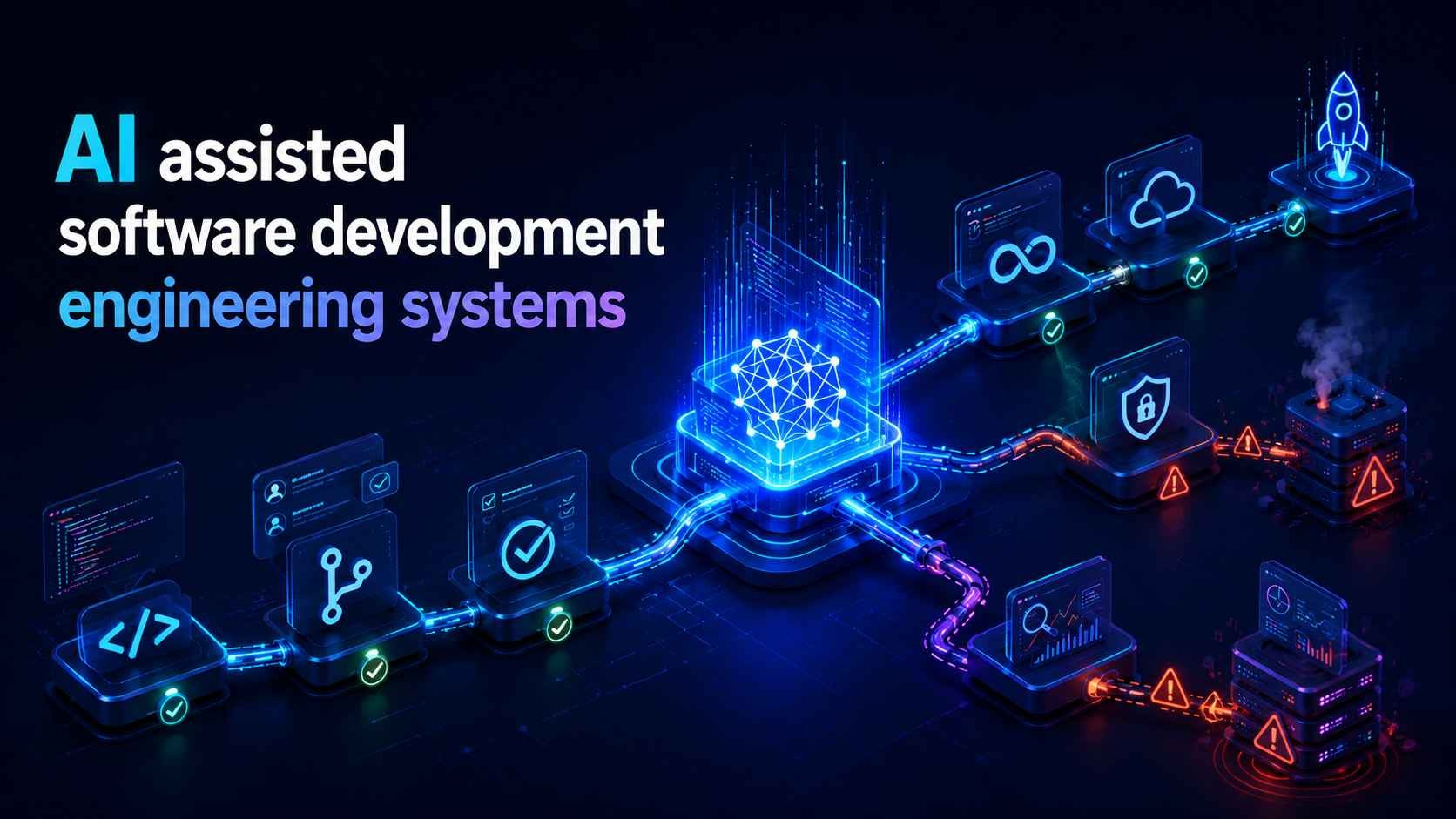
AI-Assisted Software Development Needs Better Engineering Systems
AI Isn’t Exposing Weak Developers. It’s Exposing Weak Engineering Systems.
AI coding tools can generate a function in seconds.
They can explain unfamiliar code, suggest tests, refactor services, prepare documentation, and help developers move through routine implementation work faster.
Yet many engineering teams adopting these tools are discovering something uncomfortable:
The code is being produced faster, but the software is not necessarily reaching production faster.
Pull requests still wait for review.
Developers still struggle to reproduce environments.
Security approval remains slow.
Tests remain unreliable.
Deployment procedures still depend on tribal knowledge.
Documentation still falls out of date.
AI may shorten the time required to write code, but writing code was never the only constraint in software delivery.
This is why the current conversation about AI developer productivity is often incomplete.
The question is not simply whether an individual developer can complete a task faster with AI. The more important question is whether the surrounding engineering system can absorb, validate, deploy, and operate the increased volume of work.
Recent DORA research describes AI as an amplifier: it strengthens the advantages of healthy engineering organizations, but it can also magnify existing dysfunction. Individual productivity gains may be absorbed by what DORA calls downstream disorder bottlenecks in testing, security, review, deployment, and operations.
AI is not exposing a lack of developer talent.
It is exposing the systems that were already slowing developers down.
1. Faster Coding Is Not the Same as Faster Delivery
Most AI productivity claims begin at the level of the individual developer.
- How quickly can a developer complete a coding task?
- How many suggestions are accepted?
- How much time is saved while generating boilerplate?
- How many additional pull requests are opened?
These metrics are useful, but they measure only one part of a much larger system.
A feature does not create value when the first line of code is written. It creates value when it is safely running in production and solving a real user problem.
Between those two points, the work must move through several stages:
Requirement --> Implementation --> Review --> Testing --> Security validation --> Deployment --> Production operation --> User feedback
AI-assisted software development can reduce implementation time. But if every downstream stage remains unchanged, the overall delivery cycle may barely improve.
Imagine a development team that previously produced ten meaningful code changes per week. After adopting AI coding tools, it can generate fifteen.
That sounds like a productivity improvement.
But the review capacity remains ten changes.
- The testing environment can validate only eight reliably.
- The release process can deploy only six without coordination problems.
- The result is not necessarily higher throughput. It may simply be a larger queue.
- More pull requests wait for review.
- More changes compete for test environments.
- More generated code must be understood and maintained.
- More work reaches security and operations teams without corresponding improvements in their capacity.
The apparent productivity increase at one stage creates additional pressure at another.
GitHub’s research has found that developers can complete certain tasks faster with AI coding assistance and often report improved focus and satisfaction. Those benefits are real, but they do not automatically guarantee that the entire engineering organization delivers software more effectively.
The distinction matters:
Local productivity measures how quickly one activity improves.
System productivity measures how efficiently work reaches the user.
An engineering organization can improve the first while weakening the second.
2. AI Amplifies the System Around It
Every AI tool operates inside an existing engineering environment.
That environment includes:
- Repository structure
- Coding standards
- Architecture
- Documentation
- Testing practices
- CI/CD pipelines
- Infrastructure interfaces
- Security controls
- Review processes
- Ownership boundaries
- Incident response practices
When these foundations are strong, AI has useful context and clear constraints.
- It can generate code that follows established patterns.
- It can find reliable documentation.
- It can run standardized tests.
- It can interact with predictable deployment workflows.
- It can operate within clearly defined permissions.
- It can receive fast feedback when an output is incorrect.
When those foundations are weak, AI encounters the same ambiguity developers already face but at greater speed.
An undocumented service is difficult for a new engineer to understand. It is also difficult for an AI coding agent to modify safely.
An inconsistent deployment process creates friction for humans. It also makes autonomous execution unpredictable.
Weak test coverage forces developers to rely on judgment and manual validation. It gives AI-generated changes fewer automated signals about correctness.
Unclear service ownership slows incident response. It also makes it difficult to determine who should review or approve an AI-generated change.
AI does not remove these structural problems.
It interacts with them.
In some cases, it makes them more visible because the organization begins producing work faster than its systems can evaluate it.
In others, it makes them more dangerous because an automated tool can repeat a flawed action across many files, repositories, services, or environments.
This is why AI adoption can produce very different outcomes between two apparently similar teams.
One team uses AI to accelerate a mature development platform with:
- Standardized repositories
- Reliable tests
- Automated policy checks
- Reproducible environments
- Clear service ownership
- Safe deployment automation
Another team adds the same AI tool to an environment with:
- Fragmented documentation
- Manual releases
- Inconsistent architecture
- Unclear permissions
- Flaky pipelines
- Limited observability
The first team increases engineering flow.
The second team increases engineering activity.
Those are not the same outcome.
3. The Hidden Bottlenecks AI Cannot Fix
AI coding tools are often introduced as a solution to developer productivity.
But many of the largest productivity constraints are not coding problems.
They are coordination, platform, process, and feedback problems.
Waiting for access
A developer may generate an infrastructure configuration in minutes but wait days for credentials, permissions, or an approved environment.
AI improves the task.
It does not remove the queue.
Waiting for reviews
AI can help prepare a pull request, summarize changes, and suggest reviewers.
But if ownership is unclear or senior engineers are overloaded, the change still waits.
Generating more pull requests may make the review bottleneck worse.
Unreliable test environments
An AI tool can produce tests, but it cannot compensate for an unstable test environment, inconsistent fixtures, or integration dependencies that regularly fail.
When feedback cannot be trusted, speed creates uncertainty rather than confidence.
Manual deployment procedures
AI may generate deployment instructions, but a release process that depends on manual coordination, private knowledge, and one specific operator remains fragile.
The implementation becomes faster while delivery remains slow.
Fragmented internal tooling
Developers already spend significant time switching between dashboards, ticketing systems, cloud consoles, documentation platforms, repositories, and communication tools.
Adding another AI interface may increase cognitive load unless it is integrated into a coherent workflow.
Unclear architecture
AI can generate code that looks correct locally while violating architectural assumptions that exist only in the minds of experienced engineers.
Without explicit boundaries, the tool optimizes for task completion rather than system integrity.
Weak observability
If teams cannot see how services behave in production, they cannot confidently evaluate the operational effect of AI-generated changes.
Faster implementation without faster feedback increases the cost of mistakes.
None of these issues can be solved by improving the model’s prompt alone.
They require changes to the engineering environment.
4. From Developer Enablement to Engineering-System Readiness
Giving developers access to AI tools is relatively easy.
Preparing an engineering organization to benefit from those tools is more difficult.
This requires moving from an AI adoption mindset to an AI readiness mindset.
Adoption asks:
Which AI coding assistant should we purchase?
Readiness asks:
What must be true about our engineering system for AI-generated work to move safely and efficiently?
A useful way to evaluate readiness is through five connected layers.
The Featmate AI Delivery Readiness Framework
Context --> Workflow --> Platform --> Guardrails --> Feedback
Each layer determines whether AI creates sustainable improvement or simply produces more engineering activity.
Layer 1: Context
AI systems depend on usable context.
That includes more than the source code currently open in an editor.
Useful engineering context may include:
- Architecture decisions
- Repository conventions
- API contracts
- Service dependencies
- Operational runbooks
- Security policies
- Definition-of-done criteria
- Ownership metadata
- Known failure patterns
When context is fragmented, outdated, or inaccessible, AI must infer how the system works.
Those inferences may appear convincing while being operationally incorrect.
Engineering teams should therefore treat documentation and structured knowledge as part of their AI infrastructure.
The goal is not to document everything.
The goal is to make important constraints discoverable at the moment a developer or agent needs them.
Layer 2: Workflow
AI must operate inside a defined software delivery workflow.
A generated change should not move directly from a prompt to production.
The workflow should define:
- How tasks are scoped
- Which repositories may be changed
- Which tests must run
- Who reviews the result
- What evidence is required
- How deployment is approved
- How changes are rolled back
Without a clear workflow, every AI interaction becomes an isolated experiment.
With a clear workflow, AI becomes one participant in an observable engineering process.
Layer 3: Platform
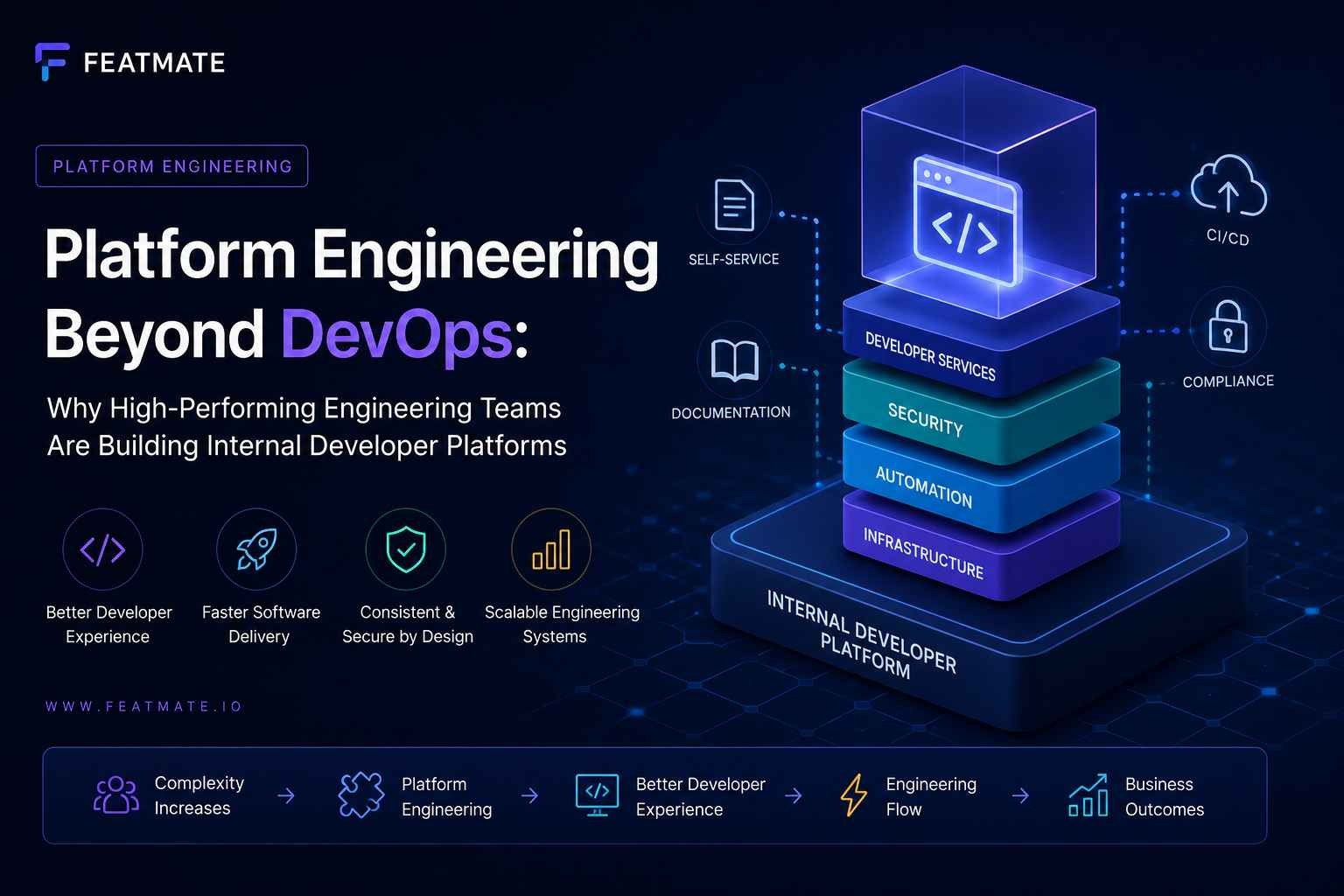
Internal platforms provide repeatable paths through complex engineering environments.
They can offer standardized templates, automated environments, approved infrastructure components, self-service capabilities, and consistent deployment interfaces.
This becomes increasingly important when AI accelerates implementation.
The platform absorbs complexity so that both developers and AI agents can use safe, supported paths instead of reconstructing infrastructure decisions for every task.
DORA’s platform engineering guidance emphasizes that AI gains can disappear when work encounters downstream disorder. Strong internal platforms help convert local coding improvements into broader organizational performance.
A good platform does not remove developer choice.
It makes the safe and common path easier than the improvised one.
Layer 4: Guardrails
As AI tools gain broader access, engineering controls must become more explicit.
Guardrails may include:
- Repository-level permissions
- Read-only and write-access separation
- Protected production environments
- Automated policy checks
- Dependency scanning
- Test requirements
- Cost limits
- Tool-call restrictions
- Human approval for high-risk actions
- Emergency stop mechanisms
The purpose of guardrails is not to prevent AI use.
It is to define the boundary within which the system can operate safely.
A capable agent without constraints is not necessarily more productive.
It may simply have a larger failure radius.
Layer 5: Feedback
AI-assisted workflows require rapid, trustworthy feedback.
The system must be able to answer:
- Did the change pass its tests?
- Did it follow architectural standards?
- Did deployment succeed?
- Did latency or error rates change?
- Did users experience a regression?
- Did the agent repeat an unsuccessful action?
- Did cost or token usage become abnormal?
- Was human intervention required?
Without these signals, teams cannot distinguish useful acceleration from hidden instability.
Feedback also allows the organization to improve its prompts, tools, workflows, and platform capabilities over time.
AI readiness is therefore not a one-time implementation.
It is a learning system.
5. How Engineering Leaders Should Measure AI Productivity
Engineering leaders should be cautious about measuring AI success through generated code volume.
Lines of code, accepted suggestions, prompt counts, and pull request totals can indicate tool usage, but they do not prove that the organization is delivering better outcomes.
A stronger measurement model connects AI adoption to the full software delivery system.
Flow metrics
Measure whether work moves through the system more efficiently:
- Lead time for changes
- Pull request review time
- Deployment frequency
- Queue time between stages
- Time spent waiting for environments
- Time from completed implementation to production
Quality metrics
Determine whether faster generation is creating additional risk:
- Change failure rate
- Escaped defects
- Rework rate
- Test failure patterns
- Rollback frequency
- Security findings
- Production incidents connected to AI-generated changes
Developer experience metrics
Evaluate whether AI reduces or relocates engineering friction:
- Time spent searching for information
- Cognitive load
- Frequency of manual handoffs
- Confidence in internal tools
- Ease of completing common workflows
- Human override rate for AI-assisted tasks
Business outcome metrics
Connect technical improvements to user and organizational value:
- Time to deliver validated customer outcomes
- Reliability of released capabilities
- Cost of delivery
- Customer adoption
- Revenue impact
- Reduction in operational risk
A team may generate code 30% faster while deployment lead time remains unchanged.
That is an implementation improvement, not yet a delivery improvement.
Similarly, a team may merge more pull requests while experiencing more regressions and rework.
That is higher activity, not higher productivity.
The correct question is not:
How much code did AI generate?
It is:
Did AI help the engineering system deliver useful, reliable change with less friction?
6. The Real Opportunity: Redesigning the Engineering System
The most valuable outcome of AI adoption may not be faster coding.
It may be that AI forces organizations to confront problems they have tolerated for years.
Poor documentation becomes impossible to ignore when agents cannot find reliable context.
Unclear ownership becomes visible when generated changes have no obvious reviewer.
Flaky pipelines become more expensive when code volume increases.
Manual approvals become more frustrating when implementation time falls from hours to minutes.
Fragmented platforms become a strategic limitation when teams try to scale AI beyond individual experimentation.
This is not a reason to slow down AI adoption.
It is a reason to broaden its scope.
The organizations that gain the most from AI-assisted software development will not simply give every developer a coding assistant.
They will redesign the systems around software delivery.
They will improve documentation because context is infrastructure.
They will strengthen testing because automated generation needs automated validation.
They will invest in internal platforms because faster implementation requires faster, safer paths to production.
They will make operational boundaries explicit because AI agents need constraints.
They will measure end-to-end flow because local speed can hide system-wide delay.
AI does not eliminate the need for Platform Engineering, DevOps, Developer Experience, SRE, or strong technical leadership.
It makes those capabilities more important.
The faster code can be generated, the more valuable the surrounding delivery system becomes.
Conclusion
AI is already changing how software is written.
But the organizations that focus only on code generation are likely to overestimate its impact.
Engineering productivity has never depended solely on typing speed.
It depends on how effectively ideas move through implementation, review, validation, deployment, operation, and feedback.
AI can accelerate one part of that journey.
It cannot independently repair the rest.
When engineering foundations are strong, AI multiplies their value.
When workflows are fragmented, environments are unreliable, and delivery processes are slow, AI magnifies those weaknesses.
That leads to a simple conclusion:
AI is not exposing weak developers.
It is exposing weak engineering systems.
The next stage of AI adoption will not be won by the organization that generates the most code.
It will be won by the organization that builds the best system for turning faster implementation into safe, reliable, and valuable software delivery.
Building AI-assisted engineering workflows requires more than adding another development tool.
Featmate connects organizations with specialists in AI Engineering, Platform Engineering, DevOps, Cloud Infrastructure, and Developer Experience who can help build the systems required for reliable AI-enabled software delivery.
Tags
Categories (22)
- All (27)
- Network Administration (4)
- Virtualization (2)
- DevOps (6)
- Backup (0)
- Web Hosting Control Panel (0)
- Cloud Management (0)
- Server Management (1)
- Database (1)
- Cybersecurity (1)
- Programming & Tech (0)
- Artificial Intelligence (AI) (9)
- Engineering Productivity (1)
- Platform Engineering (2)
- AI Strategy & Consulting (0)
- LLM Integration & Application Development (0)
- AI Agents & Workflow Automation (0)
- Machine Learning Engineering (0)
- Model Training & Fine-Tuning (0)
- MLOps & AI Infrastructure (0)
- Data Engineering for AI (0)
- AI Security, Safety & Compliance (0)
- AI Delivery & Fractional Leadership (0)


Join as a freelancer or client
Join as a Freelancer
Join as a Client